
EUPEX leverages the best of the assets developed in previous H2020 projects to design, build and validate the first HPC platform integrating the full spectrum of European HPC technologies, from architecture, processors and interconnect to system software. This exascale platform, named the EUPEX Pilot, will be co-designed with European industrial, research organisations and universities.
The pilot system has been conceived as modular, thanks to the OpenSequana-compliant hardware platform and the matching HPC software ecosystem implementing the Modular Supercomputing Architecture. This enables EUPEX to integrate and efficiently manage a variety of hardware modules, including upcoming architectures, and to handle heterogeneous workflows.
The EUPEX technology developed for the Pilot is now contributing directly to JUPITER, Europe’s first exascale supercomputer. In particular, the blade architecture developed within EUPEX will be used in JUPITER, which will integrate Rhea1, the most complex European processor ever developed, designed by SiPearl. JUPITER therefore represents a major opportunity to demonstrate the maturity, scalability and industrial readiness of the European technologies developed through EUPEX, bringing them from a European pilot system to a production-scale exascale supercomputer.
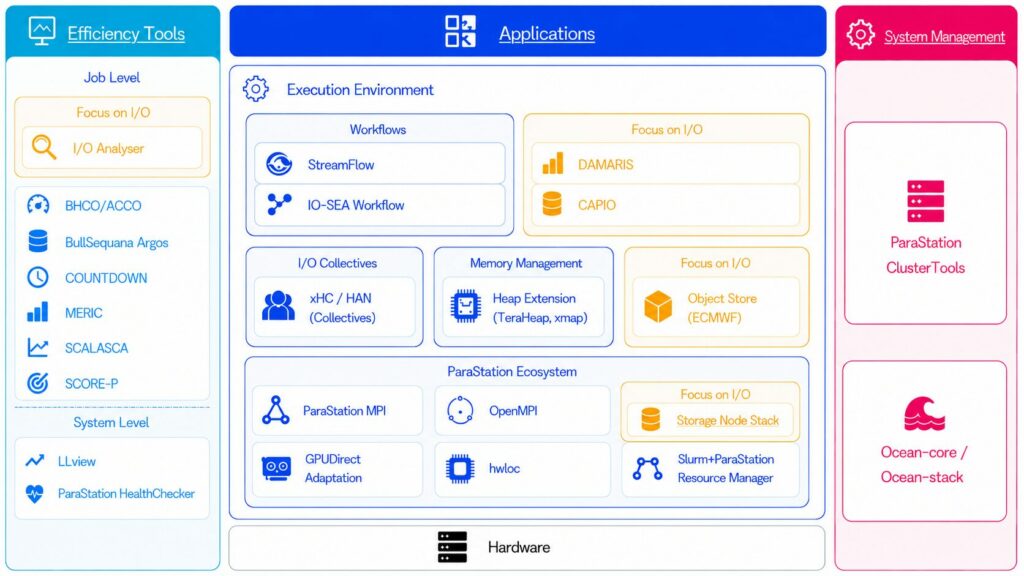
A key outcome of EUPEX is also the development of a European software stack for the operation and optimisation of large-scale HPC and AI systems. This ecosystem addresses both the needs of system operators and those of application developers and users, providing the tools required to operate, manage, monitor and optimise heterogeneous systems efficiently. It enables European users to operate exascale HPC and AI workloads with flexibility, performance and energy efficiency, while ensuring that applications can fully exploit the capabilities of the underlying European hardware.
The project places a strong emphasis on preparing applications and users to operate efficiently on upcoming exascale architectures. This effort goes well beyond hardware, with a particular focus on energy efficiency. Dedicated software tools are developed and deployed to monitor energy consumption and optimise codes so as to reduce the overall power usage of HPC clusters. A representative set of applications, spanning climate and weather forecasting, biology and health, remote sensing analysis, material science, astrophysics, engineering and seismology, is optimised for the target architecture, benchmarked on the EUPEX Pilot, and analysed to provide recommendations for future European exascale systems.
The EUPEX consortium brings together 17 European organizations in a balanced alliance between established European technology suppliers and vendors, recognized research organisations and universities, European-scale computing centres, and application owners. This mix of public and private sector stakeholders ensures that the innovative research carried out by the consortium will quickly translate into European-grown industrialised solutions that will reduce Europe’s dependence on foreign supercomputing technologies.
In a context where the European Union is striving to regain its digital sovereignty, turning from a simple user of computer technologies into a self-reliant player capable of designing, developing, manufacturing, marketing and efficiently using all the necessary technological bricks, it is an essential asset to master extreme-scale supercomputing technologies, an asset whose success will percolate through the entire computing continuum.
More information on the EUPEX website: https://eupex.eu/